European Spatial Biology Conference explores new frontiers in biomedical research and medicine
More than 700 experts from around the world will attend the 3rd Conference of the European Society for Spatial Biology (ESSB), taking place from 28 September to 1 October, to explore how spatial biology is transforming our understanding of cells, tissues and disease.
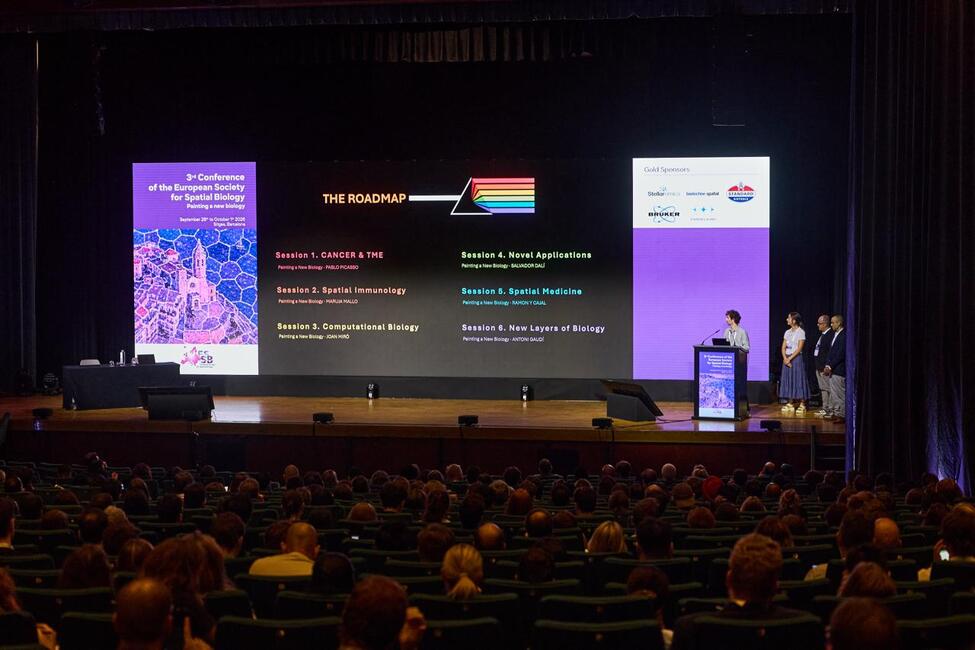
Under the theme Painting a New Biology, the town of Sitges, near Barcelona, has become a European meeting point for spatial biology, hosting the 3rd Conference of the European Society for Spatial Biology (ESSB2026). The organisation brings together researchers, pathologists, oncologists, bioinformaticians and pharmaceutical companies with the aim of promoting the use of spatial biology to advance our understanding of disease mechanisms. Over four days, from 28 September to 1 October, more than 700 experts from around the world will share the latest advances in a field that is transforming the way we understand our biology and complex diseases such as cancer.
Organised by Dr Anna Pascual, Dr Eduard Porta, Dr Miguel Reina-Campos and Dr Xavier Rovira, with the support of the National Centre for Genomic Analysis (CNAG), the Josep Carreras Leukaemia Research Institute (IJC), the La Jolla Institute for Immunology (LJI) and the Institute for Bioengineering of Catalonia (IBEC), respectively, the conference will address the challenges and new opportunities in one of the fields currently transforming biomedicine. One of the factors behind its rapid progress is the emergence of new platforms, such as the first 3D spatial transcriptomics technology to arrive in Spain, which was recently installed at CNAG. These technologies are opening up new ways of analysing gene activity at the cellular level in its native context, providing a more accurate view of our organs.
From spatial research to medicine
Through scientific talks, panel discussions and a new flash talk format aimed at early-career researchers, the conference will cover the main disciplines currently driving the field of spatial genomics, from cancer and the tumour microenvironment to spatial immunology, computational spatial biology, spatial medicine, and the new applications and layers of information that these technologies are opening up to improve human health.
Among the keynote speakers are Dr Garry Nolan of Stanford University School of Medicine, who will discuss the study of cancer and its microenvironment, and Dr Fabian Theis of the Technical University of Munich, who will explore the use of large language models to understand interactions between tumours and the immune system.
Spatial biology is also opening up new opportunities for haematological malignancies. For the Josep Carreras Leukaemia Research Institute, these advances offer new ways to deepen our understanding of blood cancers and contribute to the development of better diagnostic and therapeutic approaches.
When science becomes art
In addition to showcasing the latest scientific advances in spatial biology, the conference will also invite participants to discover one of its less explored dimensions: art. Images generated using spatial genomics techniques not only provide valuable molecular information, but can also become striking works of art in their own right.
This more artistic dimension will be the focus of an exhibition featuring images generated from the research of conference participants. For the first time, the images will not be judged on the basis of their scientific data, but on their visual beauty. It is a different way of “painting” biology and discovering a new dimension of science through its data.