Innomed Awards boost seven emerging biomedical projects with healthcare transfer potential
On 18 June, the third edition of the Innomed Awards took place, a day dedicated to recognising emerging biomedical projects with healthcare transfer potential, showcasing the innovative talent of the Can Ruti ecosystem and strengthening collaboration between research institutions, hospitals, healthcare centres, industry and investors. The event highlighted the role of the campus as a multidisciplinary scientific environment capable of generating excellence in research and transforming it into diagnostic, therapeutic and technological solutions with a real impact on patients and healthcare systems.
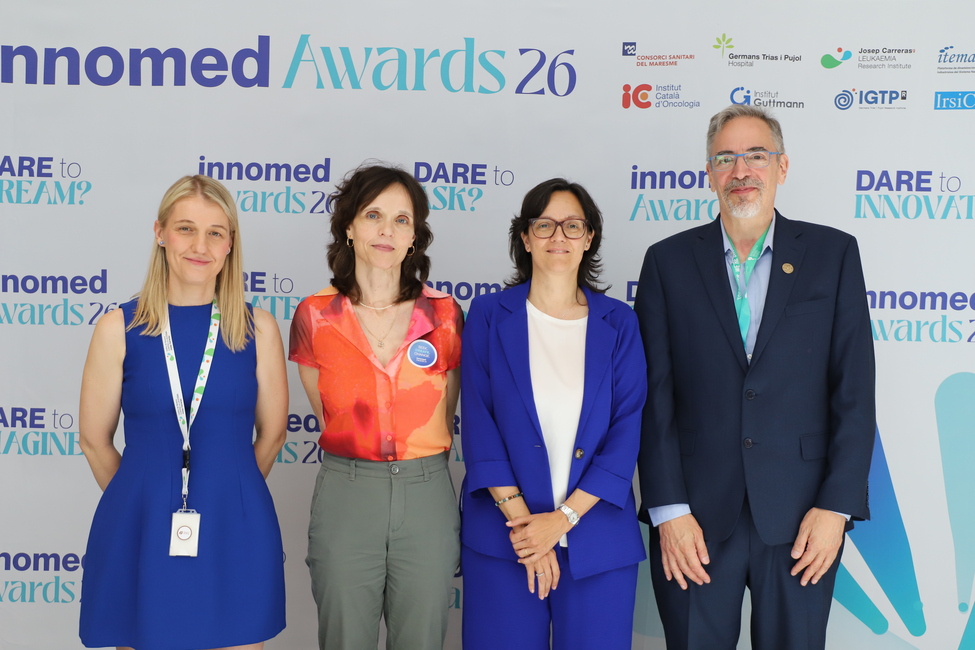
The Josep Carreras Leukaemia Research Institute hosted the latest edition of the Innomed Awards, the closing event of GrowInn, the project incubator of the Innomed programme. The event recognised the innovative potential of emerging biomedical projects and reinforced collaboration between research institutions, hospitals, healthcare centres and stakeholders from the entrepreneurial and investment ecosystem.
In this edition, 15 teams presented their projects to professionals from the scientific, clinical and business sectors, with the aim of advancing knowledge transfer and bringing new solutions closer to healthcare practice. The projects address real needs in areas such as diagnostics, medical technologies, digital health and the development of novel therapeutic strategies.
Among the seven awarded projects, PRE-T-CURE, led by Dr Laura Mondragón, researcher at the Josep Carreras Leukaemia Research Institute, was one of the selected initiatives. Standing for Pre-TCRα-guided targeted therapy for T-cell lymphomas, the project aims to develop new diagnostic and therapeutic strategies for T-cell lymphomas based on the identification of a novel biomarker discovered through animal models. Under normal physiological conditions, this biomarker is expressed only during very early stages of T-cell development; however, the researchers have detected its aberrant expression in tumour cells. The marker has been identified across several T-cell lymphoma subtypes, both at diagnosis and at relapse, highlighting its potential as a tool for patient stratification.
“Our approach is based on exploiting this target to develop precision therapies, particularly through blocking antibodies, antibody–drug conjugates and CAR-T cell therapies, with the potential to selectively eliminate tumour cells while minimising side effects. We are currently focusing on determining the proportion of patients in whom this biomarker is expressed and at which stages of the disease it appears, with the aim of advancing towards more personalised treatments tailored to the characteristics of each tumour.”
Dr Laura Mondragón, Group Leader at the Josep Carreras Institute.
The full list of awarded projects was:
PRE-T-CURE, by Laura Mondragón, from the Josep Carreras Leukaemia Research Institute, sponsored by ZBM Patents & Trademarks.
Non-invasive biomarker profiling for the detection of oropharyngeal dysphagia, by Jordi Sureda, from the Consorci Sanitari del Maresme, sponsored by Ingecal.
Blebmaker, by Marta San Roque, from IGTP, sponsored by GENESIS Biomed.
IDimmuno360, by Alba de la Puente, from the Catalan Institute of Oncology (ICO), sponsored by ClarkeModet.
Ítaca, by Àlex López, from Institut Guttmann, sponsored by Inveniam Group.
HAREH, by Eduard Badenas, from Germans Trias i Pujol University Hospital, sponsored by Itua Health.
Schisto-Stop, by Sara Cabrero, from IrsiCaixa, sponsored by ITEMAS.
Each award includes specialised services valued at €5,000, aimed at supporting teams in key aspects of project maturation, such as intellectual property protection, regulatory strategy, market validation, business development and technology transfer.
The event began with an institutional welcome featuring Ari Melnick, Director of the Josep Carreras Institute; Oriol Estrada, Director of Healthcare Strategy and Innovation at Germans Trias i Pujol University Hospital; Jordi Barretina, Director of IGTP; and Raül Zurita, Innovation Manager at IGTP. Their interventions highlighted the role of Innomed as a tool for transforming knowledge generated within the Can Ruti environment into solutions with a tangible impact on healthcare.
With this third edition, Innomed consolidates three years of activity as a programme promoting innovation in healthcare. Since its creation, the GrowInn incubator has supported 45 innovative projects, assisted more than 150 professionals, organised 25 training sessions and delivered over 100 hours of specialised training. Altogether, the programme has mobilised €85,000 in awards and services aimed at fostering the valorisation and development of projects with transfer potential.
Innomed: connected for innovation in health
Innomed is a collaborative programme designed to promote biomedical and healthcare innovation across the Can Ruti ecosystem and its surrounding environment. The initiative is led and coordinated by the Germans Trias i Pujol Research Institute (IGTP) and brings together the Josep Carreras Leukaemia Research Institute, the Consorci Sanitari del Maresme, Germans Trias i Pujol University Hospital, the Catalan Institute of Oncology (ICO), IrsiCaixa and Institut Guttmann.
The programme is structured around three main pillars: fostering a culture of innovation, incubating projects with transfer potential and promoting public-private collaboration. Through GrowInn, participating teams receive training and mentoring over a six-month period to advance the valorisation of their projects, addressing areas such as market analysis, business models, the regulation of medical products and medicines, intellectual property and technology transfer processes.